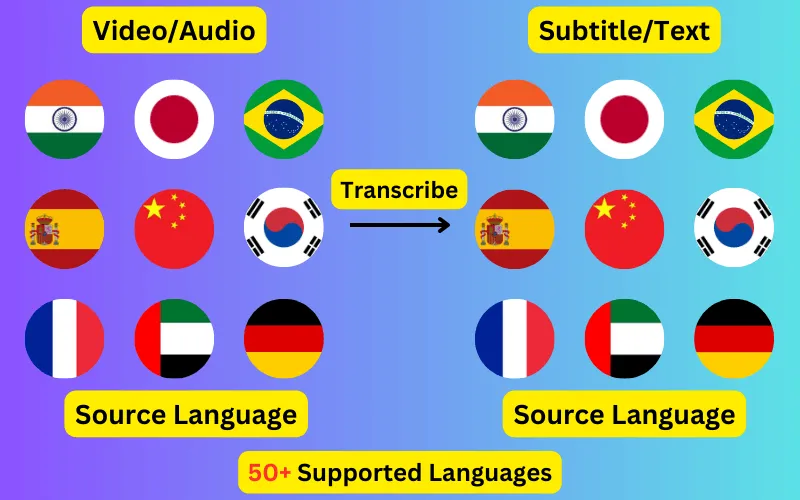
Generate Cantonese subtitles from any video or audio file. Speech is transcribed into Chinese characters with word-level timings, editable before you export it as SRT, VTT or plain text.
About Cantonese transcription
Cantonese (粵語) is written in Chinese characters and spoken principally in Hong Kong, Macau and Guangdong. Subtitles generated here come back in that script, as ordinary written Cantonese, ready to use in an SRT or VTT file.
Cantonese is a distinct spoken language from Mandarin, not an accent of it, and it has written conventions of its own for words Mandarin does not use. Select it explicitly for Hong Kong material rather than relying on Chinese.

What a Cantonese subtitle file looks like
Four lines as they come out of the exported SRT, in Chinese characters with the timings taken from the speech itself.
Cantonese is written without spaces between words, so segmentation is part of recognition rather than a tidy-up afterwards. This is why word-level timings matter more here than in a space-separated language — the boundaries are inferred, not read off the page.
Subtitle lines are worth spot-checking at their start and end, which is where those decisions land.
Tone and recording quality in Cantonese
Cantonese uses pitch to distinguish words that are otherwise the same, so recognition leans on tone as well as on the sounds. Background music costs more accuracy here than it would elsewhere, because it competes with exactly that cue.
Where tone is misheard the result is a real word rather than obvious nonsense, so errors read as plausible and are worth a deliberate check.
What people caption in Cantonese
The Cantonese material that comes through most often is Hong Kong film and TV, news, vlogs and interviews. All of it works the same way — upload the file, check the transcript, export the subtitle track.
Getting a better Cantonese transcript
Set the language to Cantonese rather than leaving detection on, particularly for clips under a minute where there is little audio to judge from.
Upload the highest-quality audio you have; compression artefacts cost more accuracy than most people expect.
Check proper nouns, place names and numbers first — recognition errors concentrate there.
Read the transcript before exporting. Cantonese subtitles are editable up until you download them.
Cantonese subtitles in another language
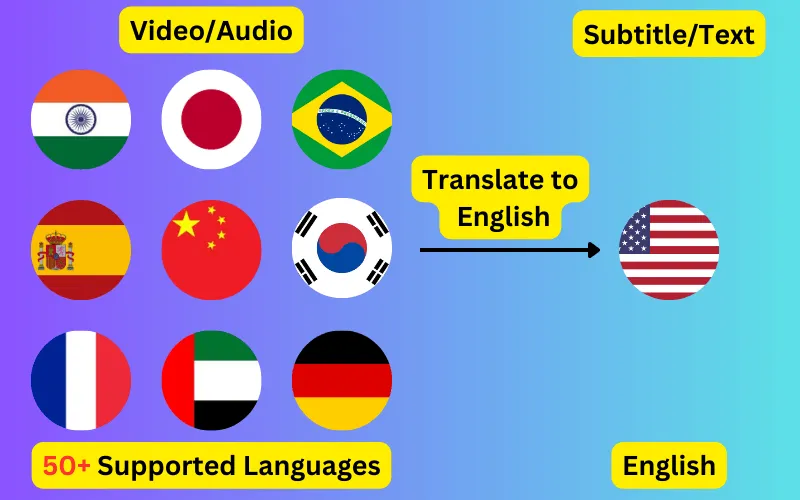
The same Cantonese audio can produce subtitles in any of the 76 supported languages instead of in Cantonese itself. English is the most common target, but every pair works, and the translated file keeps the original timings so it drops onto the same video unchanged.
Transcribe
Transcribe Your Video/Audio to Subtitles Automatically.
Accuracy depends mostly on the recording. Clear Cantonese speech with little background noise transcribes well enough to publish after a read-through; heavy noise, crosstalk and strong regional accents all reduce it. The transcript is editable before export for exactly that reason.
Can I get English subtitles for a Cantonese video?
Yes — that is translation rather than transcription. Choose Cantonese as the spoken language and English as the target, and you get an English subtitle file that keeps the original timings.
What file formats do Cantonese subtitles come in?
SRT and VTT for timed subtitle tracks, and TXT for a plain transcript with no timecodes. All three come from the same job.
Do I need to type any Cantonese myself?
No. The transcript is generated from the audio in Chinese characters. You only need to type if you decide to correct something in the editor before exporting.