Generate English subtitles for your Japanese videos
Create subtitles and text automatically with AI in 3 minutes
- Transcribe audio/video to subtitles or text.
- Translate audio/video to English subtitles or text.
- 50+ languages supported.
- Save output as subtitles or plain text.
CaptionCreator.cc is shutting down
New signups are closed. Existing users can log in to access their account and remaining credits.
Log in



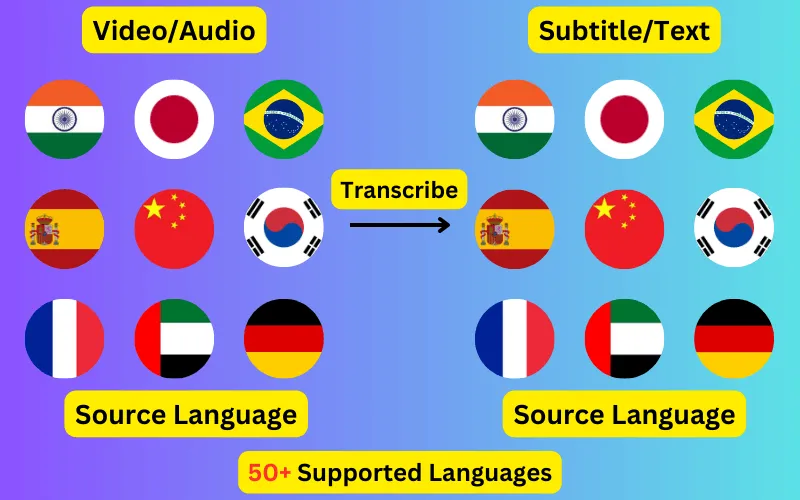
Transcribe
Transcribe Your Video/Audio to Subtitles Automatically.
50+ Languages supported (See List)
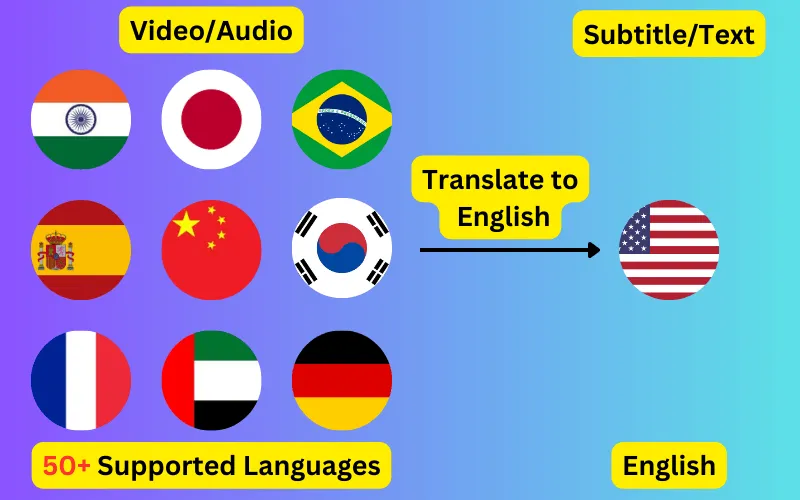
Translate To English
Translate Video/Audio to English Subtitles Automatically.
50+ Supported Languages (See List)
Supports Noisy Audio
Translate or transcribe audios recorded in a noisy environment with great accuracy.
Multilingual audio
Have video where multiple speak different languages? No problem!
Support for Diverse Accents
Different people from different places speak the same language differently, our AI can work through it seamlessly.
Supported Languages
Afrikaans
Arabic
Armenian
Azerbaijani
Belarusian
Bosnian
Bulgarian
Catalan
Chinese
Croatian
Czech
Danish
Dutch
English
Estonian
Finnish
French
Galician
German
Greek
Hebrew
Hindi
Hungarian
Icelandic
Indonesian
Italian
Japanese
Kannada
Kazakh
Korean
Latvian
Lithuanian
Macedonian
Malay
Marathi
Maori
Nepali
Norwegian
Persian
Polish
Portuguese
Romanian
Russian
Serbian
Slovak
Slovenian
Spanish
Swahili
Swedish
Tagalog
Tamil
Thai
Turkish
Ukrainian
Urdu
Vietnamese
Welsh
See what others say about CaptionCreator
Ok, this is fast. Transcribed a 3 hour video in 3 mins.

DaFluffyPotato
(Youtuber - 84.5K subscribers - 147 videos)
This is a great product. The fact that this is multilingual, it can be a game changer for content creator especially short form!

1littlecoder
(Youtuber - 72.4K subscribers - 987 videos)
Translate to English feature is so cool.

From Scratch
(Youtuber - 65K subscribers - 2 videos)
Pay As You Need
No Subscription. Buy credits that doesn't expire.
Pay as you need
$10
- $10$200$100Click and drag for 50% off
- 100credits
- Credits don't expire
- No audio length limit
- Process unlimited files per day
- Edit subtitles
30-Day Money-Back Guarantee, No Questions Asked
We provide 30-day money back guarantee. It means that you can safely buy credits and try Captioncreator for a month. If you realize that it is not for you, you can email us within 30 days to get a full refund.
Trusted By
Contact us
hello@captioncreator.cc
Frequently asked questions
Is this free?
CaptionCreator.cc is shutting down. New signups and payments are disabled, and free usage is no longer available. Existing users can still log in and use their remaining credits.
How many videos can I do?
The number of videos you can do depends on how many credits you have. Each credit lets you do one minute of video or audio.
How long does it take?
Any length videos can be done in under 3 minutes.
Do credits expire?
Your credits don't expire as long as you use the service at least once a year. But, if you request us to delete your account, any credits you have will be deleted too.
How do I delete my account?
Send an email from the same email you used to sign up to hello@captioncreator.cc
Is it accurate?
We use the latest AI model behind the scenes, so you get the best quality results.