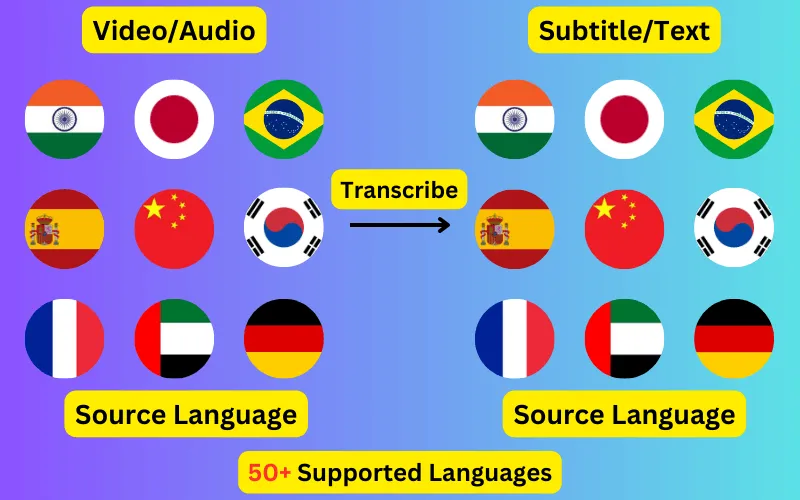
Turn Punjabi video or audio into Gujarati subtitles, exported as SRT, VTT or plain text with the original timings intact. The file comes out in the Gujarati script rather than the Gurmukhi of the audio.
From Gurmukhi to the Gujarati script
Punjabi is written in Gurmukhi and Gujarati in the Gujarati script, so the exported file uses a different writing system from the audio that produced it. The subtitle formats handle that — SRT and VTT are plain text and carry any script — but the font in whatever plays the file has to cover it.
This is the most common reason a Gujarati subtitle track looks correct in an editor and shows boxes or blanks on a device. Test on the target platform before you publish a batch.
How Punjabi audio becomes Gujarati subtitles
Audio in Punjabi (ਪੰਜਾਬੀ) is transcribed first, then translated into Gujarati (ગુજરાતી). Because the translation runs on the transcript rather than on the audio, the Gujarati subtitle file keeps the timings of the original Punjabi speech — each line appears at the moment it was actually said.
Tone in the Punjabi audio
Punjabi uses tone to distinguish words that are otherwise identical, so recognition depends on pitch as well as on the sounds themselves. Background music is unusually costly here — it competes with exactly the cue the recogniser needs.
Where tone was misheard, the Gujarati translation follows the wrong word rather than producing obvious nonsense, so errors read as plausible. A pass over the transcript before translating is worth more on Punjabi than on most languages.
Why translate Punjabi video into Gujarati
Punjabi is spoken principally in Indian Punjab, and in Pakistan where it is written in Shahmukhi; Gujarati in Gujarat, in western India, and a large diaspora. A Gujarati subtitle track is what lets one recording reach both audiences without re-recording, re-editing or dubbing it.
Because subtitles are a separate file rather than part of the picture, you can attach several language tracks to the same video and let viewers pick.
About the Punjabi audio
Transcription here produces Gurmukhi, the script used in Indian Punjab. Punjabi spoken in Pakistan is conventionally written in the Perso-Arabic Shahmukhi script instead — the speech is largely mutually intelligible, but the two scripts are not interchangeable in a subtitle file.
About the Gujarati subtitles
The Gujarati script is closely related to Devanagari but drops the horizontal line along the top of each word, which is the quickest way to tell the two apart in a subtitle file. Business and trade recordings mix in English terms heavily, and those are transcribed as spoken rather than translated into Gujarati equivalents.
What a Punjabi to Gujarati subtitle file looks like
Four lines of Punjabi speech, transcribed and translated, as they come out of the exported SRT. The timings are the Punjabi speaker's — translation does not move them, which is why the file drops onto the original video unchanged.
Almost always, but it depends on the font rather than the file — SRT and VTT are plain text and carry the Gujarati script without difficulty. If you see empty boxes, the player is missing a font for the script, not reading the subtitles wrongly.
How do I add Gujarati subtitles to a Punjabi video?
Upload the video, set the spoken language to Punjabi and the subtitle language to Gujarati, then export the result as SRT and upload it alongside your video. Nothing is burned into the picture, so the subtitles stay switchable.
Does the Gujarati subtitle file stay in sync?
Yes. Translation happens on the transcript, so every Gujarati line inherits the timing of the Punjabi words it came from. The file will sync with the same video without adjustment.
Can I get the Punjabi transcript as well?
Yes. Transcribing Punjabi into Punjabi subtitles is a separate job on the same recording, and gives you the original-language track alongside the Gujarati one.