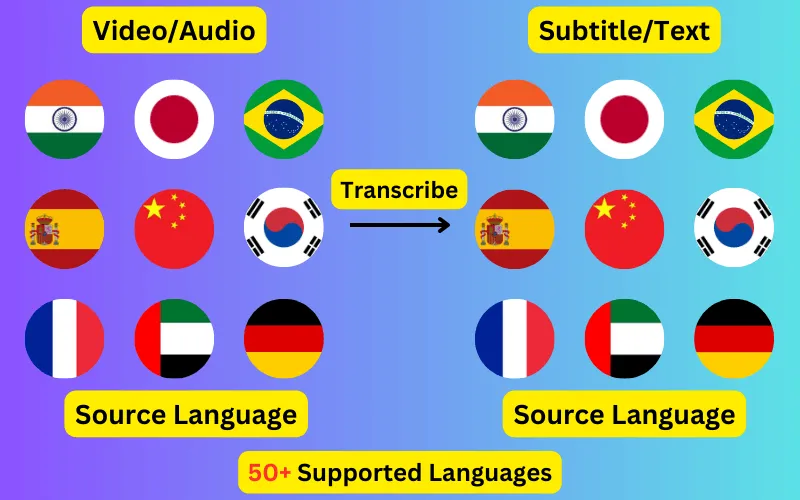
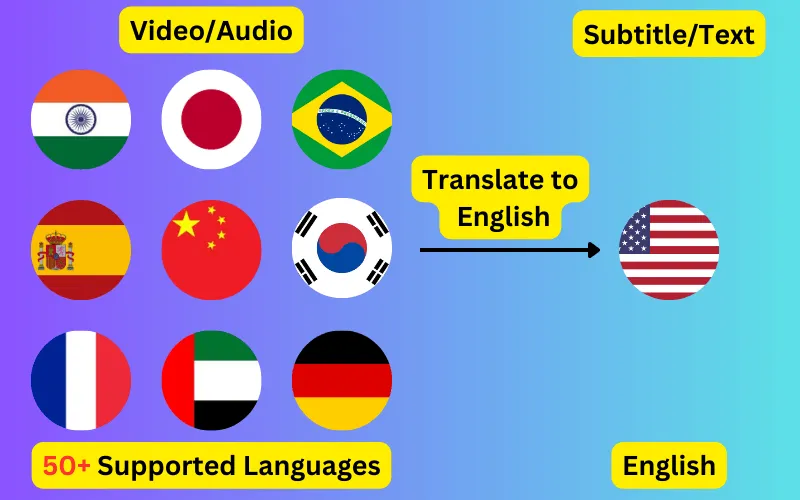
Turn English video or audio into Korean subtitles, exported as SRT, VTT or plain text with the original timings intact. The file comes out in Hangul rather than the the Latin alphabet of the audio.
From the Latin alphabet to Hangul
English is written in the Latin alphabet and Korean in Hangul, so the exported file uses a different writing system from the audio that produced it. The subtitle formats handle that — SRT and VTT are plain text and carry any script — but the font in whatever plays the file has to cover it.
This is the most common reason a Korean subtitle track looks correct in an editor and shows boxes or blanks on a device. Test on the target platform before you publish a batch.
How English audio becomes Korean subtitles
Audio in English (English) is transcribed first, then translated into Korean (한국어). Because the translation runs on the transcript rather than on the audio, the Korean subtitle file keeps the timings of the original English speech — each line appears at the moment it was actually said.
Register in Korean subtitles
Korean marks politeness grammatically, so a translator has to choose a level of formality that the English original may not have stated. The same sentence can be rendered casually or deferentially and both are accurate translations of the words.
Check the register before publishing anything with a clear audience — an interview, a lecture, a customer-facing video. It reads as a mistake to a native speaker far more readily than an awkward word choice does.
Line length in Korean
Korean builds meaning by stacking endings onto a stem, which produces fewer words but much longer ones. A English line often arrives as a shorter, denser Korean line that still overruns two rows.
Shorter blocks are the fix. Splitting a long line across two subtitle events costs nothing — the timings come from the original speech either way and stay in sync.
Why translate English video into Korean
English is spoken principally in worldwide; Korean in South Korea and North Korea. A Korean subtitle track is what lets one recording reach both audiences without re-recording, re-editing or dubbing it.
Because subtitles are a separate file rather than part of the picture, you can attach several language tracks to the same video and let viewers pick.
About the English audio
English has a wider spread of accents than any other language here, and the gap between spelling and pronunciation means recognition leans on context rather than sound alone. Names and technical terms are where errors concentrate, because those are exactly the words context cannot predict.
About the Korean subtitles
Korean marks formality grammatically, and the register a speaker uses carries real information — transcription preserves it rather than flattening everything into one politeness level. Hangul is featural and compact, so Korean subtitle lines tend to fit comfortably in two rows.
What an English to Korean subtitle file looks like
Four lines of English speech, transcribed and translated, as they come out of the exported SRT. The timings are the English speaker's — translation does not move them, which is why the file drops onto the original video unchanged.
1
00:00:01,000 --> 00:00:03,240
와 주셔서 감사합니다.

2
00:00:03,600 --> 00:00:06,120
첫 번째 질문부터 시작하겠습니다.

3
00:00:06,480 --> 00:00:09,300
제 목소리가 잘 들리시나요?

4
00:00:09,700 --> 00:00:12,040
질문은 아래에 적어 주세요.
English
Korean subtitle
Thank you all for coming.
와 주셔서 감사합니다.
Let's start with the first question.
첫 번째 질문부터 시작하겠습니다.
Can you hear me clearly?
제 목소리가 잘 들리시나요?
Please write your questions below.
질문은 아래에 적어 주세요.
What to check before publishing
Names and places, which translation handles less reliably than ordinary prose.
Idiom — a phrase that is natural in English may need loosening to read well in Korean.
Line width, since Korean packs the same sentence into longer words than English does.
That Hangul renders in your player, not just in the editor you exported from.
The level of formality, which Korean states grammatically whether or not the English original did.
Timing on fast exchanges, where two speakers overlap.
Transcribe
Transcribe Your Video/Audio Automatically, then add the subtitles to your video or export them as SRT/VTT/text.
Almost always, but it depends on the font rather than the file — SRT and VTT are plain text and carry Hangul without difficulty. If you see empty boxes, the player is missing a font for the script, not reading the subtitles wrongly.
Can I control how formal the Korean is?
Not as a setting, but the subtitles are editable before you export them, which is where register gets adjusted in practice. It is worth a pass on anything with a defined audience, since Korean marks formality grammatically and the choice is visible in every line.
How do I add Korean subtitles to a English video?
Upload the video, set the spoken language to English and the subtitle language to Korean, then export the result as SRT and upload it alongside your video. Nothing is burned into the picture, so the subtitles stay switchable.
Does the Korean subtitle file stay in sync?
Yes. Translation happens on the transcript, so every Korean line inherits the timing of the English words it came from. The file will sync with the same video without adjustment.