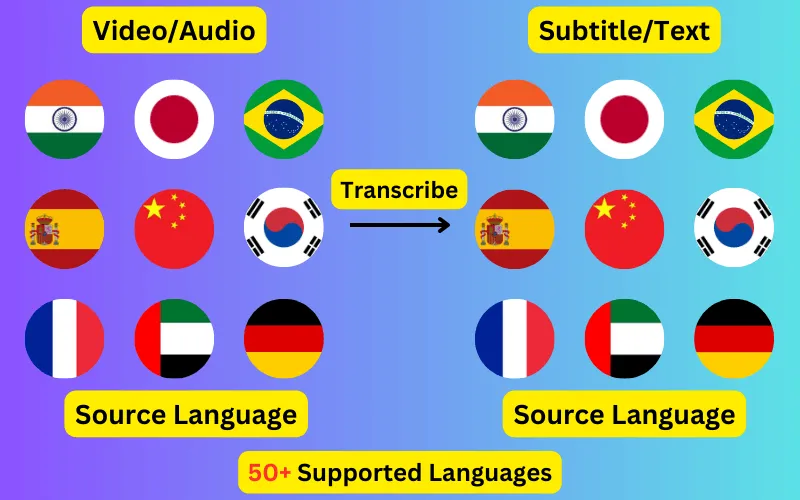
Turn Hindi video or audio into Nepali subtitles, exported as SRT, VTT or plain text with the original timings intact. Hindi and Nepali are close relatives, so set both languages explicitly rather than relying on detection.
Choosing between Hindi and Nepali
Hindi and Nepali are close enough that automatic detection between them is unreliable, especially on short clips — there is simply not enough audio to tell them apart. Set both languages explicitly here rather than leaving the source on detection.
Because the two are so close, translation between them is largely a matter of vocabulary and written convention rather than restructuring sentences. Expect a Nepali subtitle file that tracks the Hindi original almost line for line.

How Hindi audio becomes Nepali subtitles
Audio in Hindi (हिन्दी) is transcribed first, then translated into Nepali (नेपाली). Because the translation runs on the transcript rather than on the audio, the Nepali subtitle file keeps the timings of the original Hindi speech — each line appears at the moment it was actually said.
Why translate Hindi video into Nepali
Hindi is spoken principally in northern India, and widely as a second language across the subcontinent; Nepali in Nepal, and Nepali-speaking communities in India and Bhutan. A Nepali subtitle track is what lets one recording reach both audiences without re-recording, re-editing or dubbing it.
Because subtitles are a separate file rather than part of the picture, you can attach several language tracks to the same video and let viewers pick.
About the Hindi audio
Everyday spoken Hindi borrows heavily from English and from Urdu, often inside a single sentence, and recognition has to follow those switches rather than force everything into one vocabulary. Transcription keeps the Devanagari script; if you want the Roman-script form people write informally, translate to English instead of transcribing.
About the Nepali subtitles
Nepali is written in Devanagari and shares much of its vocabulary with Hindi, which makes automatic language detection unreliable between the two. Selecting Nepali explicitly is worth the extra click on anything short, where there is less audio for detection to work from.
What a Hindi to Nepali subtitle file looks like
Four lines of Hindi speech, transcribed and translated, as they come out of the exported SRT. The timings are the Hindi speaker's — translation does not move them, which is why the file drops onto the original video unchanged.
1
00:00:01,000 --> 00:00:03,240
सबैलाई शुभ प्रभात।
2
00:00:03,600 --> 00:00:06,120
आउनुभएकोमा सबैलाई धन्यवाद।
3
00:00:06,480 --> 00:00:09,300
तपाईंका प्रश्नहरू तल लेख्नुहोस्।
4
00:00:09,700 --> 00:00:12,040
अर्को पटक भेटौंला।
Hindi
Nepali subtitle
सभी को सुप्रभात।
सबैलाई शुभ प्रभात।
आप सभी के आने के लिए धन्यवाद।
आउनुभएकोमा सबैलाई धन्यवाद।
अपने सवाल नीचे लिखिए।
तपाईंका प्रश्नहरू तल लेख्नुहोस्।
अगली बार मिलते हैं।
अर्को पटक भेटौंला।
What to check before publishing
Names and places, which translation handles less reliably than ordinary prose.
Idiom — a phrase that is natural in Hindi may need loosening to read well in Nepali.
Timing on fast exchanges, where two speakers overlap.
Transcribe
Transcribe Your Video/Audio to Subtitles Automatically.
It can, if you leave the source on automatic detection — the two are close enough that a short clip does not give detection much to work with. Setting Hindi explicitly removes the guess, and is worth doing on anything under a minute.
How do I add Nepali subtitles to a Hindi video?
Upload the video, set the spoken language to Hindi and the subtitle language to Nepali, then export the result as SRT and upload it alongside your video. Nothing is burned into the picture, so the subtitles stay switchable.
Does the Nepali subtitle file stay in sync?
Yes. Translation happens on the transcript, so every Nepali line inherits the timing of the Hindi words it came from. The file will sync with the same video without adjustment.
Can I get the Hindi transcript as well?
Yes. Transcribing Hindi into Hindi subtitles is a separate job on the same recording, and gives you the original-language track alongside the Nepali one.