Turn Chinese video or audio into English subtitles, exported as SRT, VTT or plain text with the original timings intact. Chinese is written without spaces, so word boundaries are decided during recognition and carry into the translation.
Where Chinese words begin and end
Chinese is written without spaces between words, so deciding where one word stops is part of recognition rather than something applied to the transcript afterwards. That matters more here than it would for a same-language transcript: the translation into English runs on those segments, and a boundary in the wrong place changes what gets translated.
It is also why subtitle timings on Chinese audio are worth spot-checking at the start and end of each line, where segmentation decisions land.
How Chinese audio becomes English subtitles
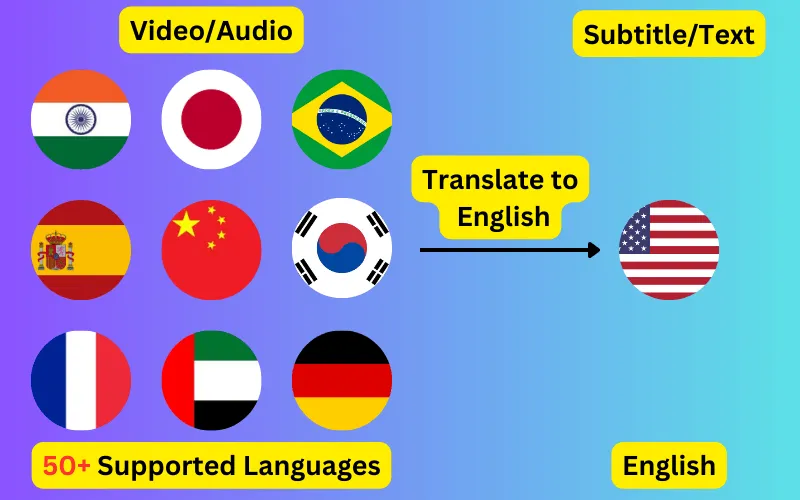
Audio in Chinese (中文) is transcribed first, then translated into English (English). Because the translation runs on the transcript rather than on the audio, the English subtitle file keeps the timings of the original Chinese speech — each line appears at the moment it was actually said.
From Chinese characters to the Latin alphabet
Chinese is written in Chinese characters and English in the Latin alphabet, so the exported file uses a different writing system from the audio that produced it. The subtitle formats handle that — SRT and VTT are plain text and carry any script — but the font in whatever plays the file has to cover it.
This is the most common reason a English subtitle track looks correct in an editor and shows boxes or blanks on a device. Test on the target platform before you publish a batch.
Why translate Chinese video into English
Chinese is spoken principally in mainland China, Taiwan, Singapore and Chinese-speaking communities worldwide; English in worldwide. A English subtitle track is what lets one recording reach both audiences without re-recording, re-editing or dubbing it.
Because subtitles are a separate file rather than part of the picture, you can attach several language tracks to the same video and let viewers pick.
About the Chinese audio
Like Japanese, Chinese is written without spaces, so word boundaries are inferred during recognition. Mandarin is what is transcribed; Cantonese is a separate option and choosing the wrong one produces fluent-looking output that does not match the audio.
About the English subtitles
English has a wider spread of accents than any other language here, and the gap between spelling and pronunciation means recognition leans on context rather than sound alone. Names and technical terms are where errors concentrate, because those are exactly the words context cannot predict.
What a Chinese to English subtitle file looks like
Four lines of Chinese speech, transcribed and translated, as they come out of the exported SRT. The timings are the Chinese speaker's — translation does not move them, which is why the file drops onto the original video unchanged.
1
00:00:01,000 --> 00:00:03,240
Good morning, everyone.

2
00:00:03,600 --> 00:00:06,120
Thank you all for coming.

3
00:00:06,480 --> 00:00:09,300
Can you hear me clearly?

4
00:00:09,700 --> 00:00:12,040
That's all for today.
Chinese
English subtitle
大家早上好。
Good morning, everyone.
感谢大家的到来。
Thank you all for coming.
你们能听清楚我说话吗?
Can you hear me clearly?
今天就到这里。
That's all for today.
What to check before publishing
Names and places, which translation handles less reliably than ordinary prose.
Idiom — a phrase that is natural in Chinese may need loosening to read well in English.
That the Latin alphabet renders in your player, not just in the editor you exported from.
Timing on fast exchanges, where two speakers overlap.
Transcribe
Transcribe Your Video/Audio Automatically, then add the subtitles to your video or export them as SRT/VTT/text.
Almost always, but it depends on the font rather than the file — SRT and VTT are plain text and carry the Latin alphabet without difficulty. If you see empty boxes, the player is missing a font for the script, not reading the subtitles wrongly.
How do I add English subtitles to a Chinese video?
Upload the video, set the spoken language to Chinese and the subtitle language to English, then export the result as SRT and upload it alongside your video. Nothing is burned into the picture, so the subtitles stay switchable.
Does the English subtitle file stay in sync?
Yes. Translation happens on the transcript, so every English line inherits the timing of the Chinese words it came from. The file will sync with the same video without adjustment.
Can I get the Chinese transcript as well?
Yes. Transcribing Chinese into Chinese subtitles is a separate job on the same recording, and gives you the original-language track alongside the English one.